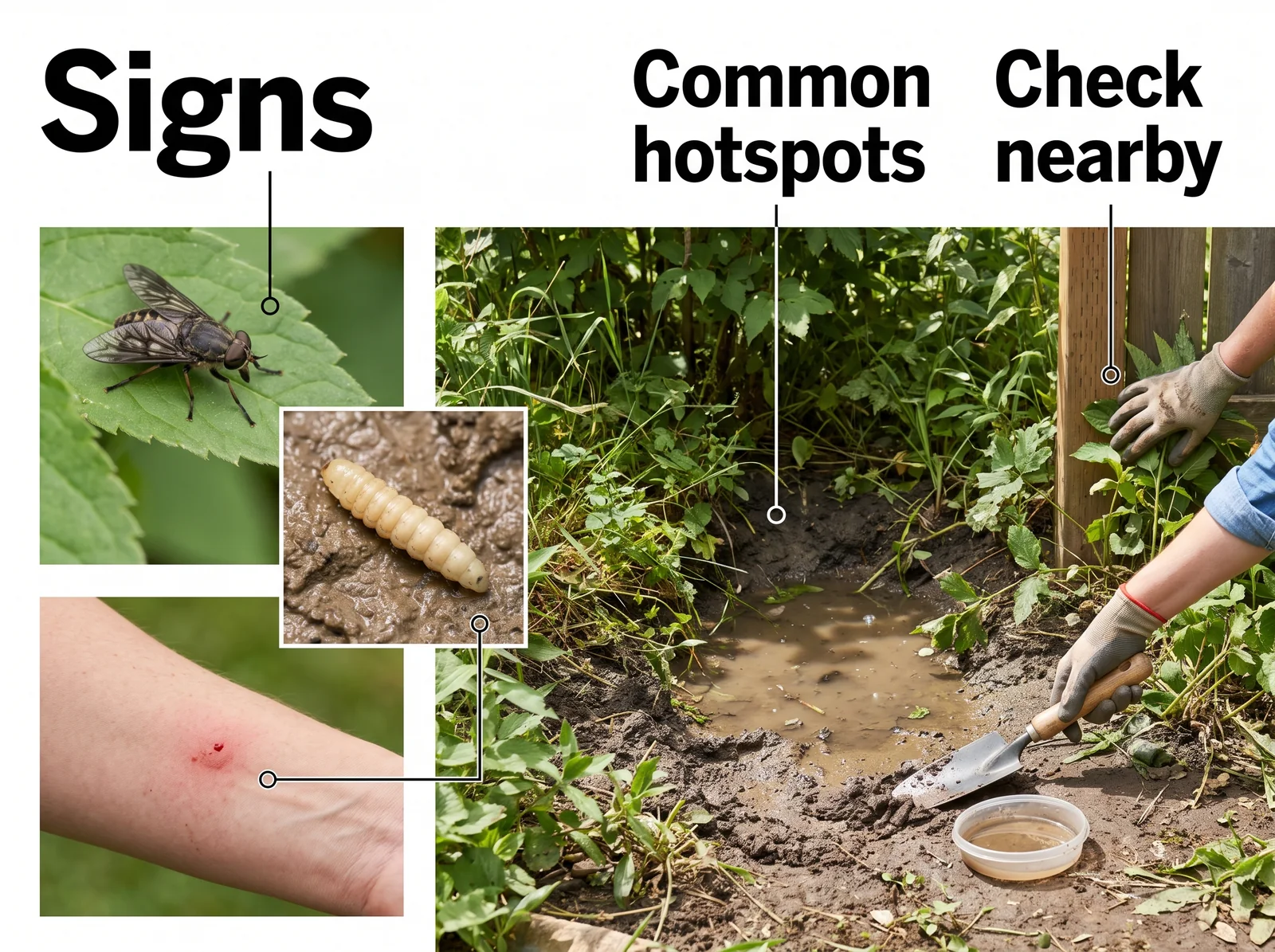
What natural habitats produce deer fly larvae?
Deer flies begin their life cycle in wet, organic-rich soil rather than open, deep water. Female deer flies deposit clusters of dark eggs on aquatic plants, low-hanging leaves, or cattails directly overhanging muddy ground or slow-moving water.
Once the eggs hatch, the tiny larvae drop down into the wet substrate. They burrow into saturated mud, decaying leaf litter, swamp margins, or damp ditch beds, where they feed on organic debris and small aquatic organisms before emerging as adults.
- Freshwater marsh edges and wooded swamps
- Muddy borders of farm ponds, retention basins, and lakes
- Slow-moving stream banks with dense vegetation
- Drainage ditches that hold moisture and rotting leaves
How far will adult deer flies travel from their breeding site?
Adult deer flies are strong, persistent fliers that rarely stay directly at their breeding site once they emerge. While they prefer staying near moist, sheltered areas, a female searching for a blood meal can easily fly anywhere from a few hundred yards to over a mile away from her birthplace.
This flight range means the source creating your yard problem might not be on your immediate property. A neighboring drainage easement, a wooded creek down the road, or a community wetland can easily supply your yard with hungry adult flies all summer long.
How can you track deer fly flight patterns on your land?
You can pinpoint the direction of the source by observing where deer flies first encounter you. Take a walk around your property during warm, sunny mid-morning or early afternoon hours when these insects are most active.
Notice which boundary line or woodlot edge triggers the first buzzing around your head. Deer flies usually wait in shaded brush along tree lines before darting out at moving targets. If you consistently get swarmed when approaching a specific fence line or tree canopy, the breeding ground is likely just beyond that shelter.
What wet zones should you inspect around your yard?
Walk your grounds to check for small, hidden micro-habitats that stay wet for weeks at a time. Natural wetlands are the primary producer, but artificial drainage issues on residential properties can also sustain deer fly larvae.
Look for low spots in your lawn where water pools after rain, neglected swales filled with fallen leaves, or overflow areas near outdoor spigots and air conditioner condensate lines. Even heavily irrigated garden beds with thick layers of soggy mulch can provide adequate moisture for larvae to survive.
Can you find deer fly larvae during an inspection?
Locating the actual larvae is difficult because they remain buried in mud and dark muck under several inches of debris. Deer fly larvae are cylindrical, tapered at both ends, and usually whitish or light brown, but digging for them rarely helps you solve an active swarm.
Instead of hunting for individual larvae, focus your time on mapping the muddy, semi-aquatic zones that meet their requirements. Identifying the wet conditions is faster, easier, and gives you actionable information about which areas need drainage improvements or brush clearing.
Where do adult deer flies rest when they are not hunting?
When deer flies are not actively pursuing people, pets, or livestock, they seek shelter in tall vegetation. They avoid dry, exposed turf in favor of tall grasses, dense shrubbery, overgrown weeds, and the low branches of shade trees.
These resting zones act as staging areas between the wet breeding grounds and your patio or lawn. Inspecting dense foliage along the perimeter of your yard reveals where adults wait in ambush for movement and warmth.
What physical traps help locate high-activity zones?
You can use physical monitoring tools to confirm which parts of your yard experience the heaviest fly traffic. Deer flies are strongly attracted to dark, moving silhouettes, especially blue and black shapes.
Setting up slow-moving or stationary sticky traps—such as blue plastic cups or dark spheres coated with insect adhesive—around your property perimeter helps you monitor entry points. Check trap catches daily to see which sector of your property captures the highest numbers, pointing you back toward the active source.
Questions you may still have
Can deer flies breed in standard swimming pools or birdbaths?
No. Deer flies require saturated soil, mud, or organic muck for their larvae to develop. They do not reproduce in clean, open water like birdbaths or chlorinated swimming pools, though they will readily fly across open pools to target swimmers.
Does standing water in clogged gutters produce deer flies?
It is very unlikely. Clogged gutters often breed mosquitoes, but deer flies require muddy, semi-aquatic substrate with decomposing vegetation typically found at ground level in natural wetland edges, damp ditches, and boggy ground.
Why do deer flies circle around your head when tracking them?
Deer flies hunt visually and hone in on carbon dioxide, body heat, and movement. They naturally target the highest point of a moving silhouette, which is usually your head, neck, or shoulders as you walk through their territory.